

What Is HHC? Properties, Uses, and Everything You Need to Know
What is Specialty Coffee?
To give you the most direct answer, specialty coffee refers to the highest quality of coffee beans available, which must score 80 points or higher on a strict 100-point scale.
When people ask what is specialty coffee, they often confuse it with “gourmet” or “premium” marketing labels. True specialty status is a certified title.
The entire journey of the bean must meet rigorous standards:
- Microclimate: Grown in ideal, specific environments.
- Harvesting: Hand-picked at peak ripeness (only red cherries).
- Processing: Meticulously cleaned and dried without defects.
- Roasting: Crafted to highlight natural flavors rather than mask them.
This meticulous care ensures that the final brew lacks the bitter, burnt defects of commercial coffee. Instead, it highlights naturally sweet, floral, fruity, or nutty tasting notes.
The Golden Score: How Quality is Measured
This scoring system is managed by the Specialty Coffee Association (SCA). Certified experts known as “Q-Graders” evaluate the raw and brewed beans.
They look at specific attributes such as fragrance, aroma, flavor, aftertaste, acidity, body, and balance.
| SCA Score Range | Quality Classification | Market Availability |
| 90.0 – 100.0 | Outstanding (Rare Masterpiece) | Less than 1% of global coffee |
| 85.0 – 89.99 | Excellent (Exemplary Profiles) | Elite specialty shops & auctions |
| 80.0 – 84.99 | Very Good (Standard Specialty) | Premium roasters & cafes |
| Below 80.0 | Commercial Grade | Supermarkets & instant brands |
Which Coffee is Best? Understanding Varieties and Origins
When trying to figure out which coffee is best, the honest answer is that it depends entirely on your personal palate.
Just like choosing between different types of rolling papers, the “best” choice is the one that fits your unique taste profile.
Coffee is grown in what is known as the “Bean Belt”—the equatorial region between the Tropics of Cancer and Capricorn. The soil, altitude, and climate of each specific country completely change how the bean tastes.
- African Origins (e.g., Ethiopia, Kenya): Known for bright acidity, floral aromas, and fruit-forward, tea-like notes.
- Latin American Origins (e.g., Colombia, Guatemala): Famous for a balanced body, crisp acidity, and sweet notes of caramel, chocolate, and nuts.
- Asian Origins (e.g., Sumatra, Indonesia): Characterized by a heavy body, low acidity, and deep earthy, spicy, or herbal flavor profiles.
Arabica vs. Robusta: The Battle for Your Palate
The global coffee market is dominated by two main plant species: Arabica and Robusta.
| Feature | Arabica Coffee | Robusta Coffee |
| Flavors | Sweet, fruity, complex, and acidic | Bitter, woody, rubbery, and dark |
| Caffeine Content | Lower (approx. 1.2% – 1.5%) | Higher (approx. 2.2% – 2.7%) |
| Growing Altitude | High (600m – 2000m+) | Low (0m – 800m) |
| Market Share | ~60% – 70% (Premium market) | ~30% – 40% (Commercial market) |
Because of these stark differences, the specialty coffee industry almost exclusively uses 100% Arabica beans to ensure a smooth, premium experience.
Single Origin vs. Blends: Which One Should You Choose?
- Single Origin: The beans come from one specific place, whether that is a single country, region, or even a single estate farm. Choose this if you want to experience the pure, unblended “terroir” and unique flavor characteristics of that specific land.
- Blends: A mix of beans from different origins combined by roasters. Choose this if you prefer a well-rounded, consistent, and balanced flavor profile that tastes exactly the same all year round.
The Role of Specialty Coffee Roasters
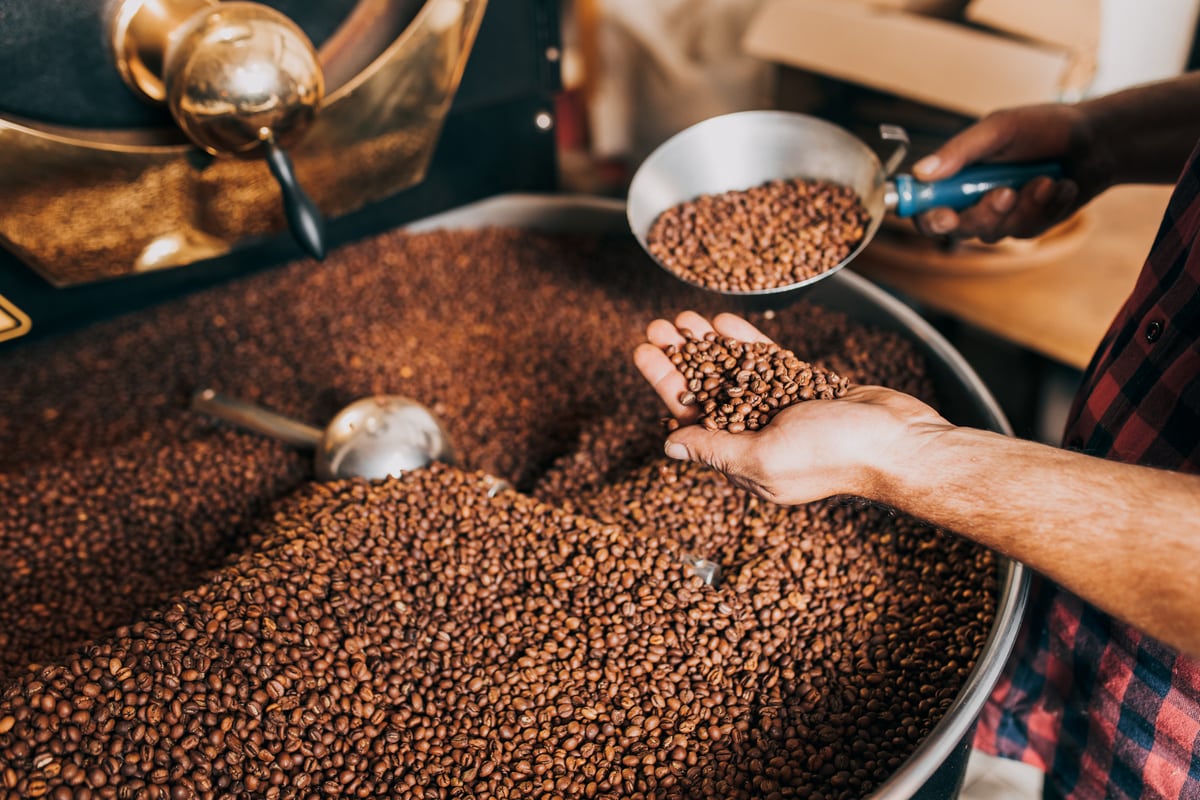
The coffee farmers do the hard work of growing the potential, but the specialty coffee roasters are the magicians who unlock it.
Raw coffee beans are actually green, spongy seeds that smell like fresh grass. Roasting is the precise process of applying heat to turn those green seeds into brittle, brown, aromatic gems.
Specialty roasters focus on highlight-roasting rather than over-roasting. They use lighter profiles to preserve the bean’s natural acidity and unique regional flavors.
Commercial brands often roast their beans to a dark, oily crisp to hide defects and ensure every batch tastes identical (usually like ash). Specialty roasters do the opposite. They treat each batch like a unique recipe, adjusting time and airflow to let the bean’s true personality shine.
Can You Get High-End Flavor Without the Buzz? Decaf Specialty Coffee
For a long time, decaf had a terrible reputation. People assumed it was chemically altered, stale, and completely devoid of any real flavor.
Thankfully, decaf specialty coffee has completely shattered that stereotype. Modern specialty roasters understand that some coffee lovers want the incredible sensory experience of a premium brew without the late-night jitters.
To achieve this, the specialty industry avoids harsh chemical solvents like methylene chloride to strip the caffeine. Instead, they use natural, water-based methods:
- The Swiss Water Process: A chemical-free method using pure water, temperature, and carbon filters to gently remove 99.9% of the caffeine.
- Flavor Preservation: Because no chemicals touch the beans, the natural essential oils, sweetness, and complex origin notes remain completely untouched.
The result is a decaf cup that tastes just as vibrant, sweet, and complex as its fully caffeinated counterparts.
Specialty Coffee and Smoking: Elevating Your Daily Ritual
At Smoking, we are obsessed with the finer details of our habits. We believe that life shouldn’t be rushed, and that the things we enjoy deserve our full attention.
That is why pairing a high-end specialty coffee with your smoking ritual makes perfect sense. It is the ultimate combination of texture, aroma, and relaxation.
Think about the sensory overlap:
- The Contrast: A bright, citrusy, washed Kenyan coffee can cut through a heavy smoke, refreshing your palate between drags.
- The Synergy: A natural-process Brazilian or Colombian coffee can bring out a rich, molasses-like sweetness that grounds the earthy notes of your smoke.
Next time you sit down to relax, don’t just grab a basic cup of commercial diner coffee. Take your time.
Select a high-quality single-origin bean, grind it fresh, and brew it with care. Pair it with your favorite Smoking paper, take a slow sip, and turn a simple habit into a truly elevated ritual.