

What Is Snus? Hazards, Legal Status, and What You Need to Know
What are the main types of tobacco leaves?
To give you the most direct answer, the main types of tobacco leaves used in commercial production are Virginia (Flue-Cured), Burley (Air-Cured), Oriental (Sun-Cured), and Dark (Fermented) tobacco.
When smokers research types of tobacco leaves (Virginia, Burley, Oriental and Black), they are usually looking to understand why different blends taste, burn, and feel so fundamentally distinct. While all cultivated tobacco belongs to the Nicotiana tabacum species, human cultivation has developed these four primary categories based on where they grow, how they are harvested, and how they are dried.
Here is a quick overview of how the big four stack up against each other:
| Tobacco Type | Primary Curing Method | Flavor Profile | Natural Sugar Content | Absorbency / Flavor Retention |
| Virginia | Flue-cured (Heat pipes) | Bright, sweet, grassy, citrusy | High (Up to 25%) | Low |
| Burley | Air-cured (Open barns) | Nutty, cocoa, woody, dry | Very Low (Near 0%) | Extremely High |
| Oriental | Sun-cured (Direct sunlight) | Spicy, herbal, floral, tea-like | Moderate | Moderate |
| Dark (Black) | Air-cured & Fermented | Earthy, peppery, heavy, smoky | Low | High |
The big four: A detailed breakdown of tobacco leaf varieties
Every variety of tobacco leaf brings a specific personality to a blend. Master blenders mix these four base crops like paints on a palette to craft balanced, enjoyable smokes.
Virginia tobacco: The gold standard for natural sugars and brightness
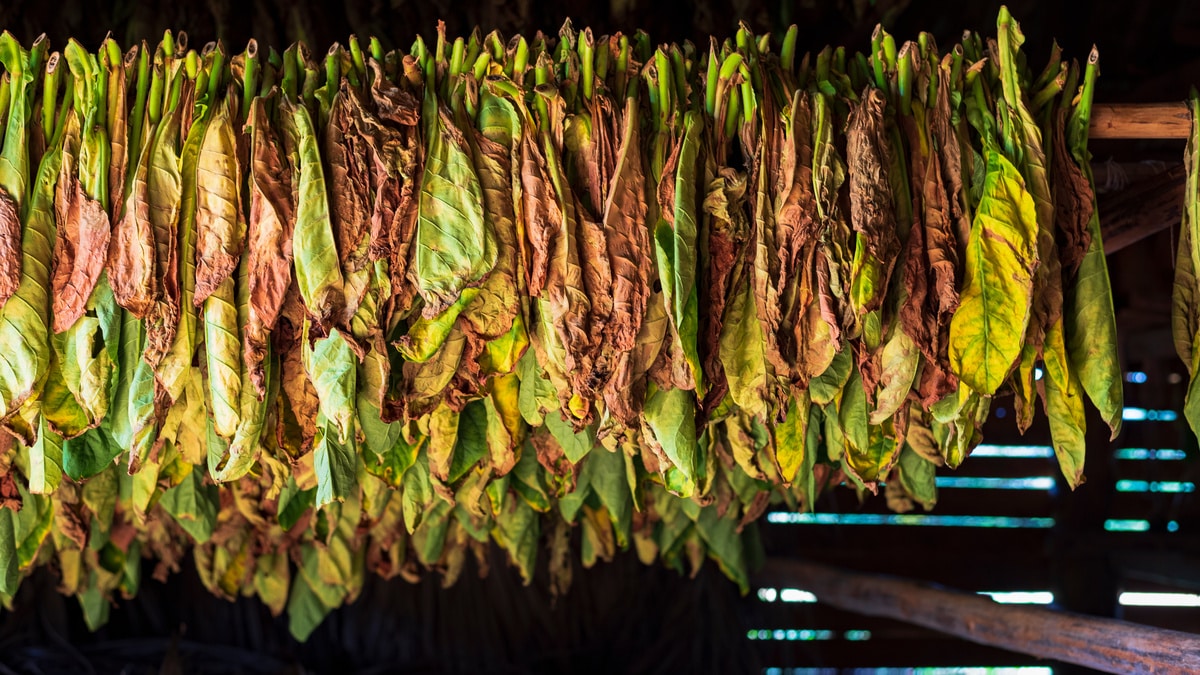
Virginia leaf—often referred to as “Bright Leaf”—is the most widely grown tobacco in the world. Harvested leaf by leaf as the plant matures, it undergoes “flue-curing.” This process hangs the leaves inside enclosed barns heated by forced hot-air pipes.
Because the heat dries the leaf quickly without direct exposure to smoke, it preserves the plant’s high natural sugar content and seals in a vibrant yellow-to-orange color. Virginia tobacco burns clean and hot, delivering a light, sweet, and zesty smoke that serves as the foundation for countless cigarette and rolling blends.
Burley tobacco: The air-cured, highly absorbent chameleon
Grown extensively across the United States and South America, Burley is a light air-cured tobacco. Farmers hang full Burley stalks in open-air barns for up to eight weeks, allowing natural breezes to dry the leaves slowly.
During this prolonged drying phase, the leaf loses almost all of its natural sugars, resulting in a rich mahogany color and a dry, nutty, slightly cocoa-like taste profile. Because Burley has a cellular structure similar to a dry sponge, it is famous for its unmatched ability to absorb added flavorings, casings, and moisture during processing.
Oriental (Turkish) tobacco: Sun-cured, small, and intensely aromatic
Originating in the Mediterranean climates of Turkey, Greece, Bulgaria, and the Balkans, Oriental tobacco is characterized by its small, delicate leaves. Entire plants are harvested and strung together in long strands to dry directly under the hot Mediterranean sun.
This sun-cured process produces small, yellowish-green leaves loaded with natural essential oils and resins. Oriental tobacco burns exceptionally cool and releases a rich, complex aroma that features notes of dried herbs, exotic tea leaves, and subtle spice.
Dark (Black) tobacco: Heavy body, fermentation, and bold tradition
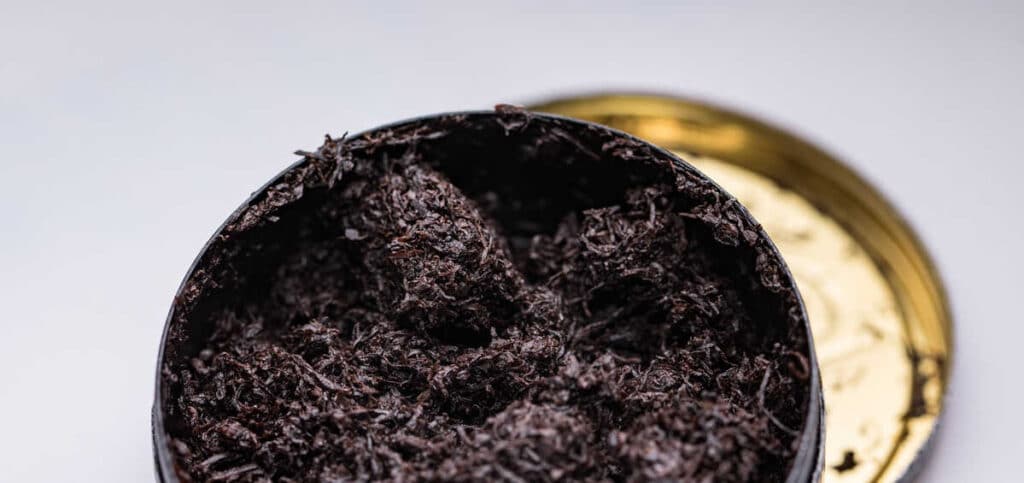
Dark tobacco is the heavyweight champion of the botanical world. Grown in rich tropical soils like those in Kentucky, Virginia, Cuba, and Indonesia, these heavy leaves are air-cured and then stacked into massive piles called “bulks” to undergo natural fermentation.
The high heat and moisture generated during fermentation break down harsh compounds, darkening the leaf into a deep chocolate or near-black hue. The result is an intensely bold, earthy, and peppery tobacco with a heavy body—traditionally favored for fine cigars, traditional pipe blends, and heavy European rolling tobaccos.
Types of Virginia rolling tobacco: Understanding blends and cuts
If you prefer rolling your own cigarettes, you are likely already familiar with Virginia leaf. When looking into types of Virginia rolling tobacco, it helps to know how different aging techniques and blending ratios alter your daily smoke.
Bright Virginia (Golden Leaf)
This is Virginia tobacco in its purest, most vibrant form. High in natural sugars and light in weight, Golden Virginia provides a crisp, sweet draw with notes of freshly cut grass and subtle honey. It is ideal for smokers who enjoy a light, breezy session with minimal heavy aftertaste.
Red Virginia (Aged & Darker Cured)
Red Virginia comes from leaves harvested higher up on the stalk that are cured longer at higher temperatures. This additional heat caramelizes the natural sugars, shifting the leaf’s color from bright yellow to a deep, reddish-brown. Red Virginia delivers a much richer, woodier, and dried-fruit flavor profile with a smoother throat hit.
Blended profiles: American Blend vs. Halfzware
Most commercial loose tobaccos combine Virginia with other leaf varieties to balance sweetness, strength, and burn rate:
-
American Blend: A classic combination of roughly 50% Virginia (for sweetness), 30% Burley (for body and throat hit), and 20% Oriental (for aroma).
-
Halfzware (Half-Heavy): A traditional Dutch-style blend combining sweet Virginia with dark, fire-cured Kentucky tobacco, creating a smoky, dark-chocolate flavor profile that remains smooth on the palate.
Key factors that create the difference between tobacco leaves
Why do two leaves grown from the exact same seed stock taste completely different? The secret lies in a combination of environmental and human factors:
-
Soil Composition: Sandy, light soils yield bright, low-nicotine leaves with high sugar content (like Virginia), while heavy, dark clay soils produce thick, nicotine-rich leaves (like Dark Kentucky).
-
Stalk Position: Leaves at the top of the plant (ligero) receive the most direct sunlight, making them strong, thick, and oily. Leaves at the bottom (volado) receive less sunlight, producing lighter, milder tobacco.
-
Curing Chemistry: Flue-curing locks in natural sugars via rapid heat. Air-curing allows enzymes to consume sugars for a drier taste. Sun-curing concentrates essential oils for intense aroma.
The art of raw materials: Pairing fine leaf with the perfect paper
At Smoking, we know that understanding your tobacco is only half the equation. The finest blend of flue-cured Virginia or aromatic Oriental leaf can easily be ruined if paired with thick, low-grade paper that tastes like burning cardboard.
To truly honor the natural flavor profile of your favorite tobacco leaf, match it with ultra-thin, slow-burning paper made from natural materials like unbleached hemp or rice paper. Thin papers allow the authentic notes of the tobacco—whether sweet, nutty, or spicy—to shine through without interference.
Take your time selecting your leaf, choose your paper with care, and enjoy every step of your rolling ritual.